
PROJECT / Custom Software
Customer 360
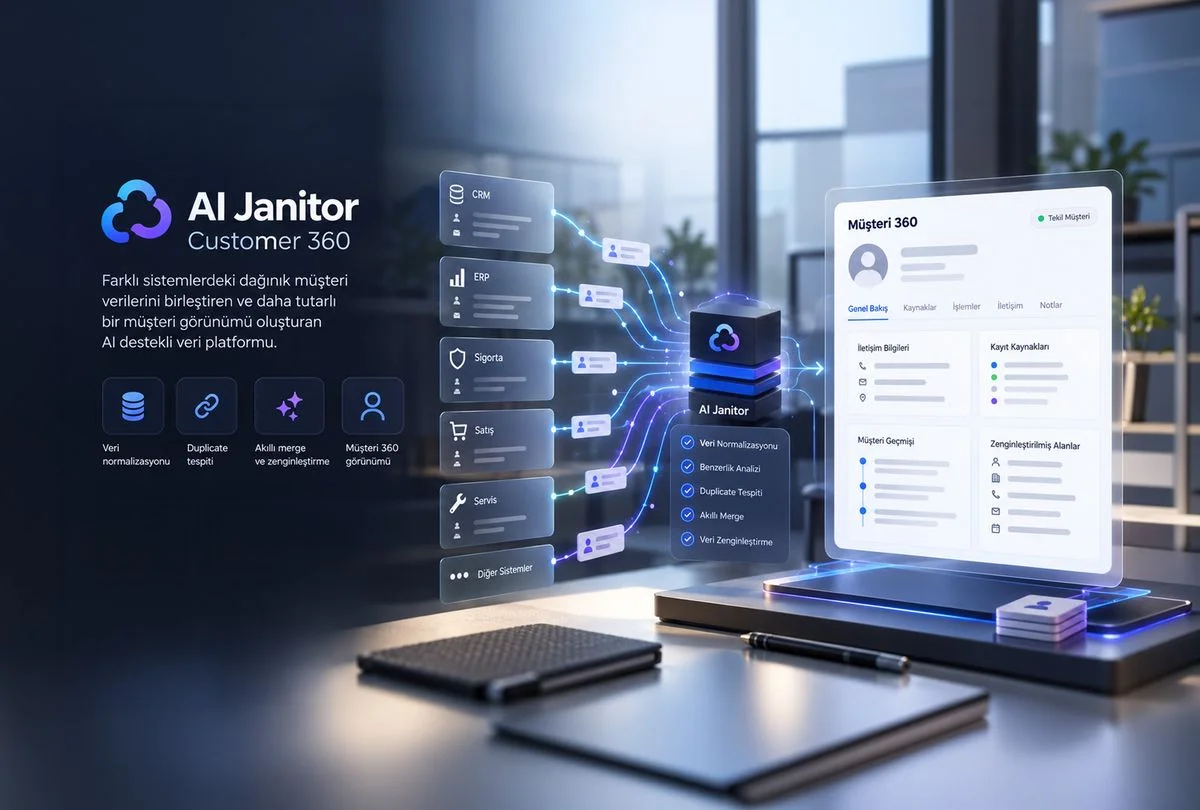
Customer 360 standardizes customer data across systems, matches and merges records belonging to the same person, and enriches missing information. Working alongside existing systems, it gives teams a more consistent view of each customer.
- Category
- Custom Software
The challenge
When the same customer becomes a different record in every system
In enterprise environments, customer data rarely originates from a single system. CRM, ERP, insurance, sales, service and other operational platforms may all create independent records for the same person. Phone numbers stored in different formats, non-standard address fields, name variations and incomplete information can gradually create multiple customer records for a single individual. This is more than a data-quality issue. When the same customer appears as several different people, reporting, customer history, campaign management, sales analysis and operational processes all become fragmented.
The need was to build an architecture that could standardize customer records from multiple sources and consolidate data belonging to the same person into a unified customer view.
What we built
- 01
Data normalization
Transforms phone numbers, addresses and similar customer fields from different sources into consistent, comparable formats.
- 02
AI-assisted duplicate detection
Uses OpenAI embeddings and Qdrant similarity analysis to identify different records that may represent the same customer.
- 03
Smart merge and master-record management
Merges duplicate customer records into a designated primary record and transfers complementary information from other sources into the main customer profile.
- 04
Data enrichment
Completes missing customer fields using internal systems or suitable third-party data sources to build richer customer profiles.
- 05
Customer 360 view
Brings customer information fragmented across multiple systems into a centralized and more consistent customer record.
The solution
Standardizing the data before looking for duplicates
The Customer 360 process does not begin by searching for duplicate records immediately. First, customer data from different systems is transformed into a common format. Phone numbers are standardized, address fields are normalized, and format differences that make comparison difficult are reduced wherever possible. This creates a consistent data foundation for the matching stages that follow.
Identifying similar records with OpenAI and Qdrant
Duplicate customer records are not always exact matches. The same person's name, address or other details may be stored with small variations across different systems. The platform uses OpenAI-based embeddings and Qdrant vector search to evaluate these kinds of records. This similarity layer makes it possible to identify not only exact matches but also records that may represent the same customer despite differences in how the data was entered.
Merging duplicate records into a main customer profile
Records identified as belonging to the same customer are not simply flagged and left unresolved. Duplicate records are merged into a designated main customer record. The goal of the merge is not merely to remove redundant records. Complementary information from different records is used to enrich the main customer profile. For example, one source may contain a more current phone number while another may contain an address or another piece of customer information that is missing elsewhere. The result is a more complete customer view built from information that was previously fragmented across multiple systems.
Enriching incomplete customer data
Customer 360 is not limited to cleaning existing records. Missing or improvable fields can also be enriched from internal systems or suitable third-party data sources. This allows the main customer record to become not only deduplicated but also more complete and useful for downstream operations.
Bringing different data sources into a shared customer model
Source systems can retain their own schemas and field structures, while Customer 360 evaluates customer information through a shared customer model. This approach creates a centralized customer-data layer without requiring every existing operational system to be replaced.
Data processing flow
| Stage | Responsibility |
|---|---|
| Data ingestion | Collect customer records from different operational systems |
| Normalization | Standardize phone, address and other comparison-critical fields |
| Similarity analysis | Detect potential duplicate records using OpenAI embeddings and Qdrant |
| Matching | Associate records that represent the same customer |
| Merge | Consolidate duplicate records into the main customer profile |
| Enrichment | Transfer complementary information from additional sources to the main record |
| Unified view | Create a more consistent and complete customer profile |
Real-world operating scale
The platform has been applied to a real dataset containing more than 400K customer records. Phone and address normalization, duplicate detection, record merging and data-enrichment flows are running in the live environment. The system is currently under live validation and monitoring.
Turn fragmented customer data into a usable data asset.
We design custom data architectures that normalize, match, merge and enrich customer records across different systems. Get in touch
Building a data layer between existing systems instead of replacing them
The core approach of Customer 360 is not to replace every operational system in the organization with a single application. Instead, customer data from different source systems passes through a centralized processing layer. This layer handles normalization, matching, merging and enrichment. Existing operational systems can continue to run while a shared customer reference model is created across them.
Combining deterministic rules with AI-based similarity analysis
Record matching is not based on AI alone. Deterministic rules can be used for standardized fields such as phone numbers, while embeddings and vector similarity are introduced when direct matching is not sufficient. This hybrid approach combines conventional data-quality rules with AI-assisted similarity analysis inside the same processing workflow.
Express-based service architecture
The backend uses a Node.js and Express service architecture. Customer processing, normalization, matching and enrichment are handled through service layers. OpenAI embeddings are used to create similarity representations, while Qdrant performs fast vector-based similarity searches across those representations.
Using the main customer record as an evolving reference
The goal of the merge process is not simply to delete redundant data, but to consolidate useful information under the correct primary customer record. The main customer profile therefore becomes a central reference that can continue to be enriched with complementary information from different sources over time.
Measurable impact
Technologies
 TypeScript
 Node.js
 OpenAI
 Qdrant
 Docker