
PROJECT / Artificial Intelligence
Candidate Assessment Platform
Our platform brings role-specific test preparation, timed candidate assessments and results analysis together to support HR teams before interviews. AI assists with evaluation, while the hiring team retains the final decision.
- Category
- Artificial Intelligence
The challenge
Managing a growing applicant pool
The idea for Adaptive Hiring Platform emerged after a low-budget LinkedIn job post published by Code64 received more than 100 applications in one day. As application volume increases, it becomes harder for hiring teams to build a reliable shortlist by reviewing CVs alone. For technical or specialist roles in particular, HR teams cannot be expected to have deep expertise in every role-specific requirement. Having the right keywords on a CV does not, by itself, demonstrate the problem-solving ability, technical approach, communication skills or scenario handling required for a specific position.
The need was to create a system that could build assessments around the actual requirements of a role, provide candidates with a consistent evaluation process, and turn the resulting data into useful decision-support context for HR.
What we built
- 01
Role-Based AI Test Generator
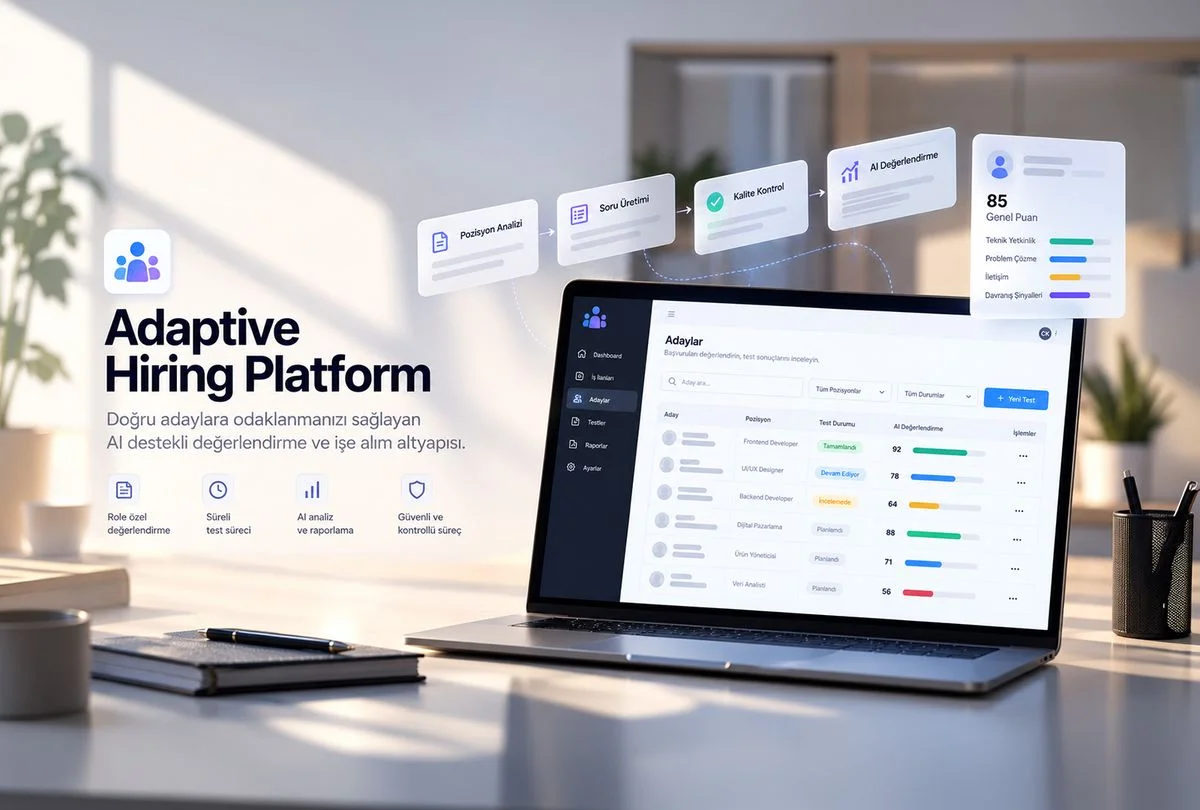
Analyzes sector, department, position, seniority level and job-posting context to build a role-specific competency structure and assessment questions. Questions pass through a separate quality-review stage.
- 02
HR Test Editor
HR teams can review AI-generated questions, edit them manually and give final approval before the assessment is published.
- 03
Timed candidate assessment
Candidates complete controlled, time-limited assessments through unique links. Answers and response durations are recorded per question.
- 04
Behavioral signals
Events such as tab switching, copy/paste attempts and response timing are recorded to provide additional context to HR. These signals are not treated as proof of cheating or candidate suitability on their own.
- 05
AI analysis and HR report
Evaluates candidate answers against role requirements and produces section-level assessments, strengths, weaknesses and supporting commentary for HR.
The solution
Starting with role analysis instead of jumping directly to questions
Test generation does not begin by simply asking an AI model to write questions. HR provides the sector, department, position, seniority level and, when available, the job posting text. The Position Analyst Agent first evaluates this context and identifies the critical competencies, assessment sections, weightings and suitable question types for the role. This means that positions such as software developer, field sales representative or digital marketing specialist are not assessed against the same generic question pool; each assessment is built around its own role context.
Generating questions with separate agents and passing them through quality review
After the competency map is created, the Question Writer Agent generates role-specific questions according to the defined sections and weightings. Before these questions are presented to HR, they are reviewed again by a separate Quality Reviewer Agent. The quality-review stage checks whether the questions are genuinely relevant to the position, whether they are clear and unambiguous, whether they match the candidate level, whether the distribution is consistent with competency weightings, and whether scenario questions are realistic and role-specific.
This creates a controlled test-generation pipeline in which distinct responsibilities review one another instead of relying on a single AI call.
Keeping HR control alongside AI
An AI-generated test is not considered final. HR teams can preview the generated questions, edit them manually, add or remove questions, and publish the assessment only after their own review. When needed, the Question Refiner Agent can also be used to request a new question or refine an existing one through natural-language instructions. AI supports and accelerates assessment design, while final control over the test remains with HR.
Providing each candidate with a controlled, timed evaluation flow
A unique link is created for each candidate assigned to an approved assessment. The candidate accesses the test through this link, and once the evaluation begins, timing is managed on the server side. Responses are stored per question and the assessment is completed within the configured time window. This creates a consistent evaluation environment across candidates.
Using behavioral signals as evaluation context
During the assessment, the system can record selected user behaviors that may provide additional context to the HR team. These signals can include tab switching, copy or paste attempts, context-menu usage, time spent on a question, response duration, unusually fast answers and connection or heartbeat interruptions. The purpose of these records is not to make a definitive judgment about a candidate's honesty or personality. For example, a tab switch alone does not prove that a candidate received external assistance.
The platform treats these events as behavioral signals that add context to the evaluation and help HR review the AI report alongside the candidate's actual answers.
Supporting pre-interview decision preparation with an AI analysis report
When the candidate completes the test, the Analysis Report Agent is triggered automatically. The agent evaluates the candidate's answers together with the position context, assessment sections, response times and relevant behavioral events. The resulting report can include an overall assessment, section-level scores, strengths, areas for improvement, answer-related observations, behavioral notes and HR-focused commentary. The goal is to provide HR with a more structured evaluation before the interview stage.
The final hiring decision remains human
Adaptive Hiring Platform does not make the final decision on whether a candidate should be hired. AI analysis is positioned as a decision-support layer for HR and hiring managers. The final evaluation and hiring decision always remain with the responsible HR team or hiring manager.
Agent and workflow structure
| Component | Responsibility |
|---|---|
| Orchestrator Service | Routes requests to the correct AI pipeline or agent and manages data flow |
| Job Posting Enrichment | Structures job-posting text for deeper analysis when available |
| Position Analyst | Defines role-specific competency maps, sections and weightings |
| Question Writer | Generates role-specific questions from the competency structure |
| Quality Reviewer | Reviews question quality, seniority fit and role relevance |
| Question Refiner | Adds or updates questions from natural-language HR requests |
| Candidate Flow | Manages unique links, timing and candidate response flow |
| Security Events | Records selected behavioral signals during the assessment |
| Analysis Report | Analyzes candidate responses and assessment context to create an HR report |
An example from Code64’s hiring process
Adaptive Hiring Platform is currently in UAT and has been tested end to end within Code64's own hiring process. The hiring process that inspired the product received more than 100 applications from a LinkedIn post in a single day. From that applicant pool, 30 candidates were moved into internal evaluation, 5 candidates were interviewed, and the process resulted in 1 hire. These figures are not used as a generalized hiring success rate or efficiency percentage. They represent a real internal hiring case in which the platform was exercised across the complete evaluation flow.
Turn high-volume applications into a more structured evaluation process.
We build role-specific AI assessments, controlled candidate testing flows and decision-support systems that keep the final judgment with your hiring team. Get in touch
An orchestrated agent architecture instead of a monolithic AI call
The platform's AI architecture does not rely on a single model request. A Node.js-based orchestrator determines which operation needs to run and executes the relevant agent chain in sequence. Test generation follows a Position Analyst → Question Writer → Quality Reviewer flow. This separates the core responsibilities of role analysis, question generation and quality assurance into distinct stages. The orchestrator handles deterministic routing and error management, while AI models are used only for their specialized tasks.
Server-managed candidate sessions
The candidate assessment flow uses single-use tokens and explicit state management. Sessions are tracked through states such as pending, started, completed or expired. Once a test begins, server-side timing prevents the evaluation flow from depending only on the candidate's browser clock.
Combining AI evaluation with behavioral context
Candidate answers and behavioral events are stored as separate data layers. During analysis, AI can use behavioral signals as supporting context alongside answer performance. This architecture positions behavioral data as an additional reporting signal rather than as an automatic judgment mechanism.
Measurable impact